The Artist
Shigeko Kubota (1937-2015, Japan, USA)
River (1979-81)
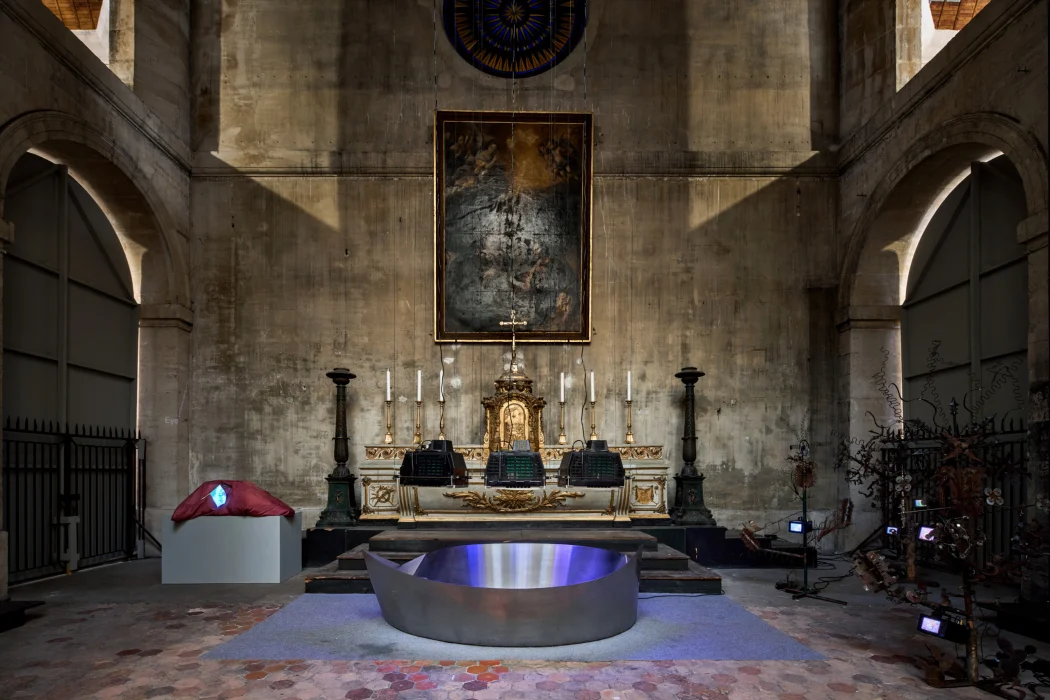
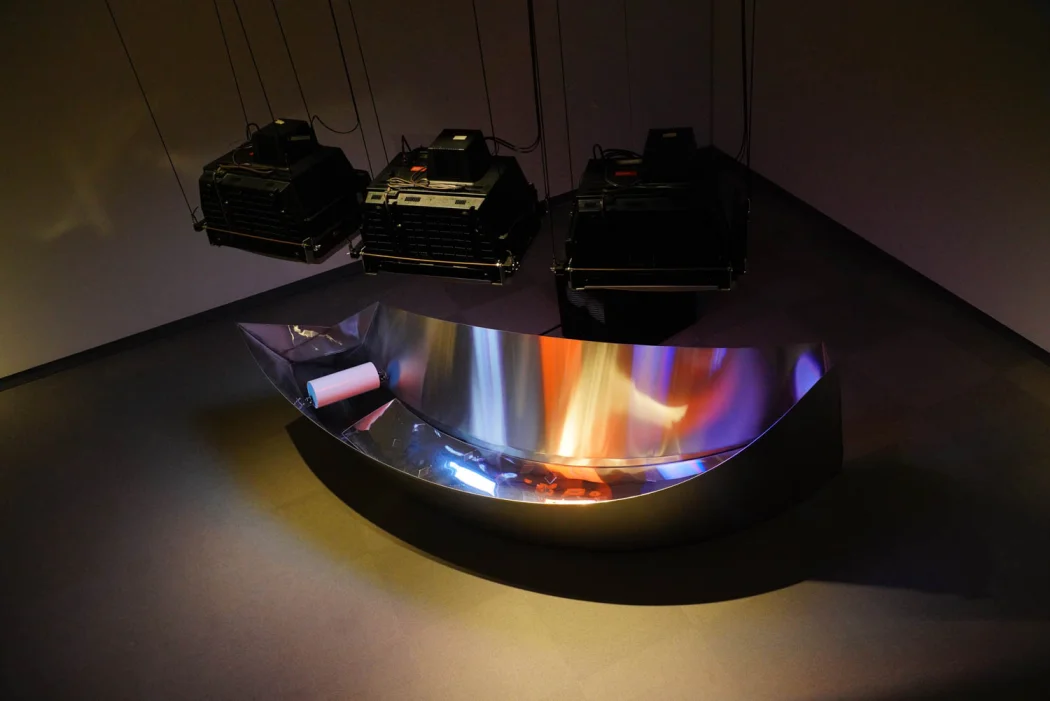
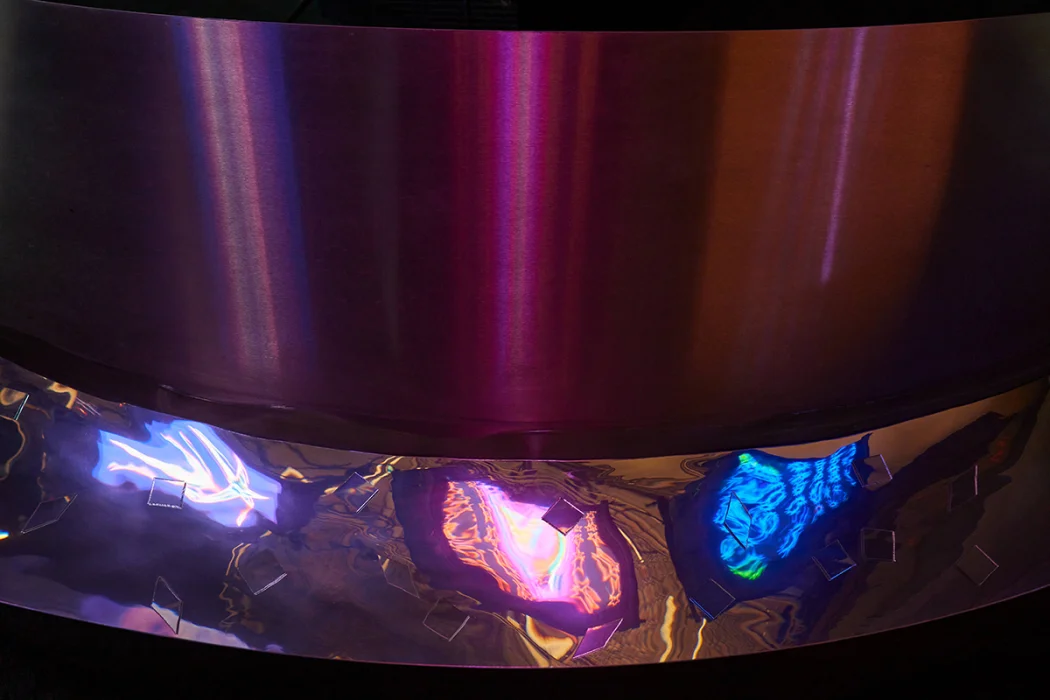
River (1979-81) is a video sculpture by Shigeko Kubota that suspends three CRT monitors above a stainless-steel basin, with the screens tilted downward just below the viewer’s line of sight. The three screens loop a single-channel video combining electronically synthesized hearts, stars, and abstract electronic feedback with colorized images of Kubota swimming in Wyoming’s Snake River, as well as excerpts from the artist’s iconic video Duchampiana: Nude Descending a Staircase, 1976. The basin, curved to resemble the meandering flow of a river, is filled with water and shards of mirrored glass that catch and scatter light. A small wave machine at its base sends gentle ripples across the surface, fracturing the reflected image, echoing the unpredictability and instability of flowing water.
Inspired by memories of the Shinano River in her childhood home in Niigata, as well as Zen Buddhist symbolism, Kubota wrote about this work, likening the movement of water to the passage of time and the persistence of memory: “A drop of rain becomes a brook, a brook becomes a river. The role of water in nature is comparable to the function of video in our life. A river is replicated in video in its physical/temporal properties and in its information-carrying and reflective, “mirror” qualities.” For Kubota, video (media), like water, carries the accumulation of memories and motion -a “liquid reality” where form, place, and time endlessly dissolve.
Shigeko Kubota was a renowned pioneer of video art. Over her five-decade career, Kubota was key to the elevation and recognition of video as fine art and particularly influential to the development of video sculpture. Kubota forged a lyrical confluence of the personal and the technological, often merging vibrant electronic processing techniques with references to Japanese spiritual traditions, images and objects of nature, art, and a diaristic investigation of her everyday life.
Select solo exhibitions include Museum of Modern Art (MoMA), New York (2021–2022); Her retrospective Viva Video, which toured to the Niigata Prefectural Museum of Modern Art, National Museum of Art, Osaka; and Museum of Contemporary Art, Tokyo (2021–22); Whitney Museum (1996); The Kitchen, New York (1975) and others. Select group exhibitions MIT List Visual Arts Center, Cambridge (2018); Whitney Museum of American Art, New York (2018); The Venice Biennale (1993); The Whitney Biennial (1983); and Documenta, Kassel (1977, 87). Her works are held in collections including The Museum of Modern Art, New York; National Portrait Gallery Smithsonian Institution, Washington D.C.; Central Pompidou, Paris; Center for Arts and Media (ZKM), Karlsruhe, and others.
The Gallery
Founded in 2006, Fergus McCaffrey is internationally recognized for its groundbreaking role in promoting the work of post-war Japanese artists, as well as a quality roster of select contemporary European and American artists. Fergus McCaffrey has been instrumental in introducing post-war Japanese art to a Western market: Gutai artists Sadamasa Motonaga, Kazuo Shiraga and Toshio Yoshida; Hi-Red-Center members Jiro Takamatsu and Natsuyuki Nakanishi; and Noriyuki Haraguchi and Hitoshi Nomura from the Mono-Ha era. The gallery also exhibits the work seminal Western artists, including Anna Conway, Marcia Hafif, Martha Jungwirth, Brian Maguire, Richard Nonas, and Carol Rama. Fergus McCaffrey Tokyo opened in May of 2018 and has since presented exhibitions by artists including Anselm Kiefer, and Richard Serra.
Information
514 West 26th Street
New York, NY 10001
USA