The Artist
Ana Mendieta (b. 1948, Havana, Cuba; d. 1985, New York, USA)
Volcán (1978)
Super 8mm film transferred to HD digital media, color, silent; 3 min. 11 sec., Ed. 8 + 3 AP
Silueta Sangrienta (1975)
Super 8mm film transferred to HD digital media, color, silent; 1 min. 51 sec., Ed. 8 + 3 AP
Birth (Gunpowder Works) (1981)
Super 8mm film transferred to HD digital media, color, silent; 2 min. 59 sec., Ed. 6 + 3 AP
Silueta de Arena (1978)
Super 8mm film transferred to HD digital media, color, silent; 1 min. 33 sec., Ed. 8 + 3 AP
Black Angel (1975)
Super 8mm film transferred to HD digital media, color, silent; 6 min. 37 sec., Ed. 8 + 3 AP
Ocean Bird (Washup) (1974)
Super 8 mm film transferred to HD digital media, color, silent; 4 min. 9 sec., Ed. 6 + 3 AP
Ana Mendieta is a multidisciplinary artist renowned for her “earth/body works,” in which she used her body — or its absence, evoked in “siluetas” (silhouettes) — in dialogue with natural elements, notably earth, fire, flowers, and water. With a practice that was often ephemeral, combining sculpture, body art, land art, photography, and film — and infused with ritual, the sacred, and a prescient ecological awareness — Mendieta addressed the major themes of the conceptual and avant-garde movements of the 1970s with a distinct voice. Creating more than 100 films and videos in her career, she is an iconic, canonical, and unclassifiable figure of the late 20th century. In the chapel’s central rotunda, six films are presented in an immersive, life-size encounter with key aspects of the artist’s practice.
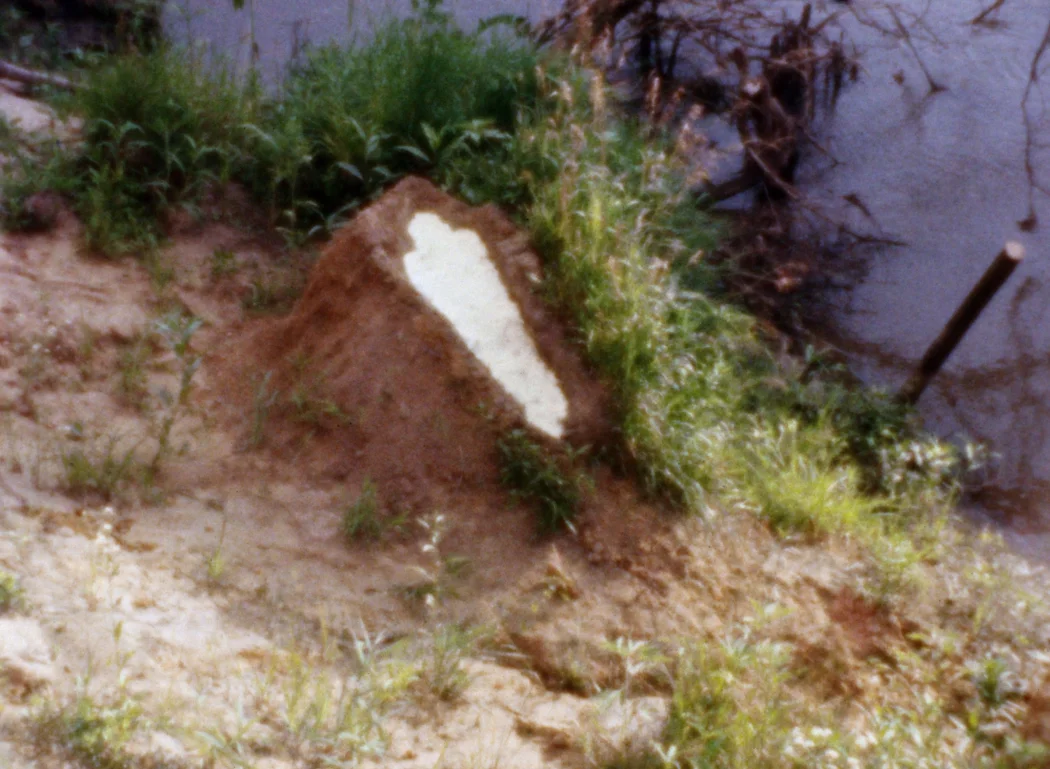
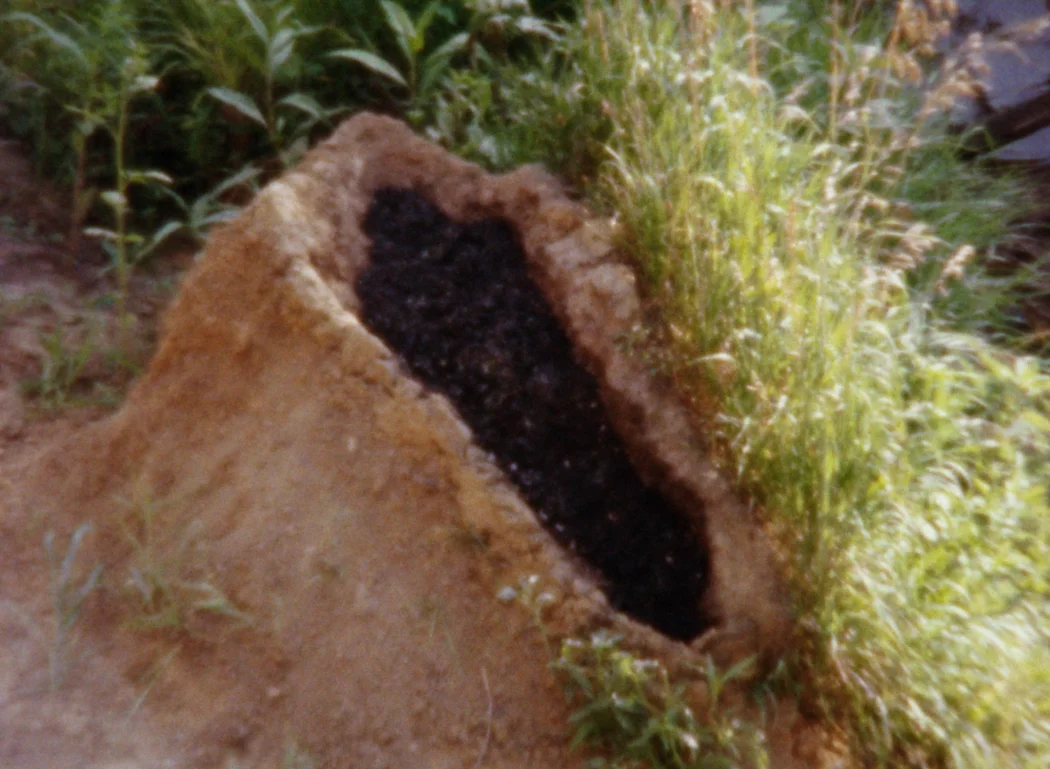
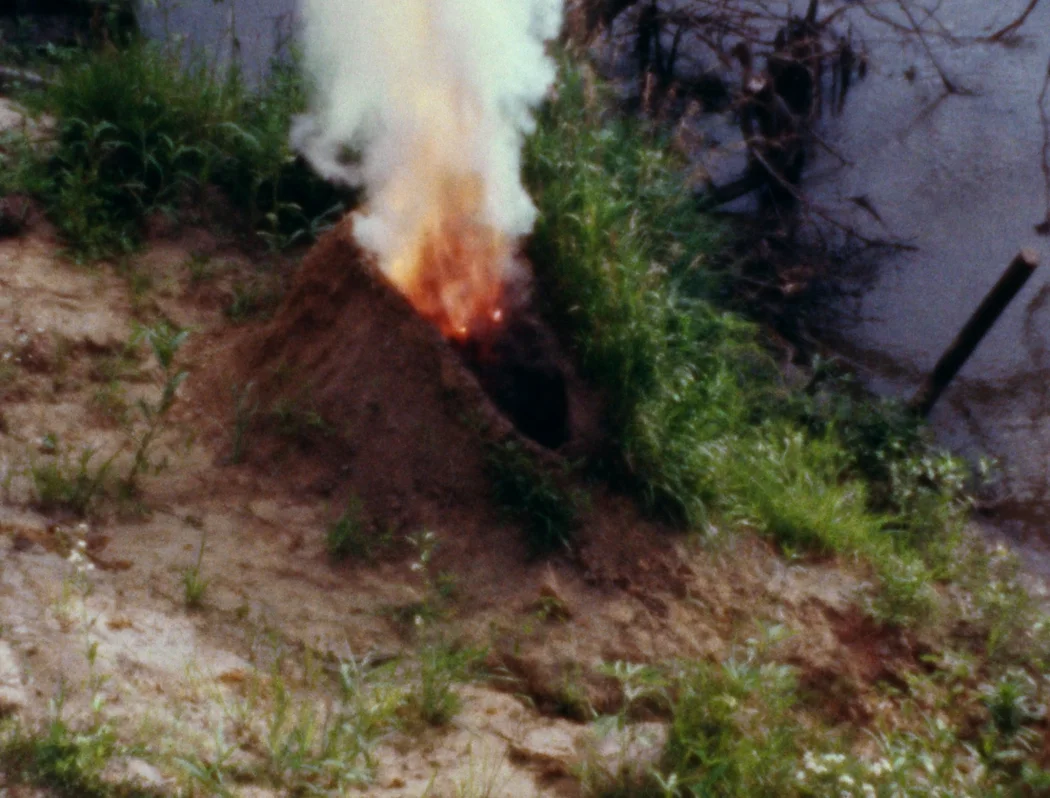
For Volcán (1978), Mendieta built a large raised Silueta from earth to create a volcano along the banks of Old Man’s Creek in Iowa. The figure is solid and deeply rooted in the landscape, its long recessed opening filled with brilliant white gunpowder. Set against the gentle shoreline, the stark white figure holds for a few moments before the powder suddenly ignites. Flames consume the Silueta, travelling up its length and transforming the bright white form into black ash as smoke billows into the air.
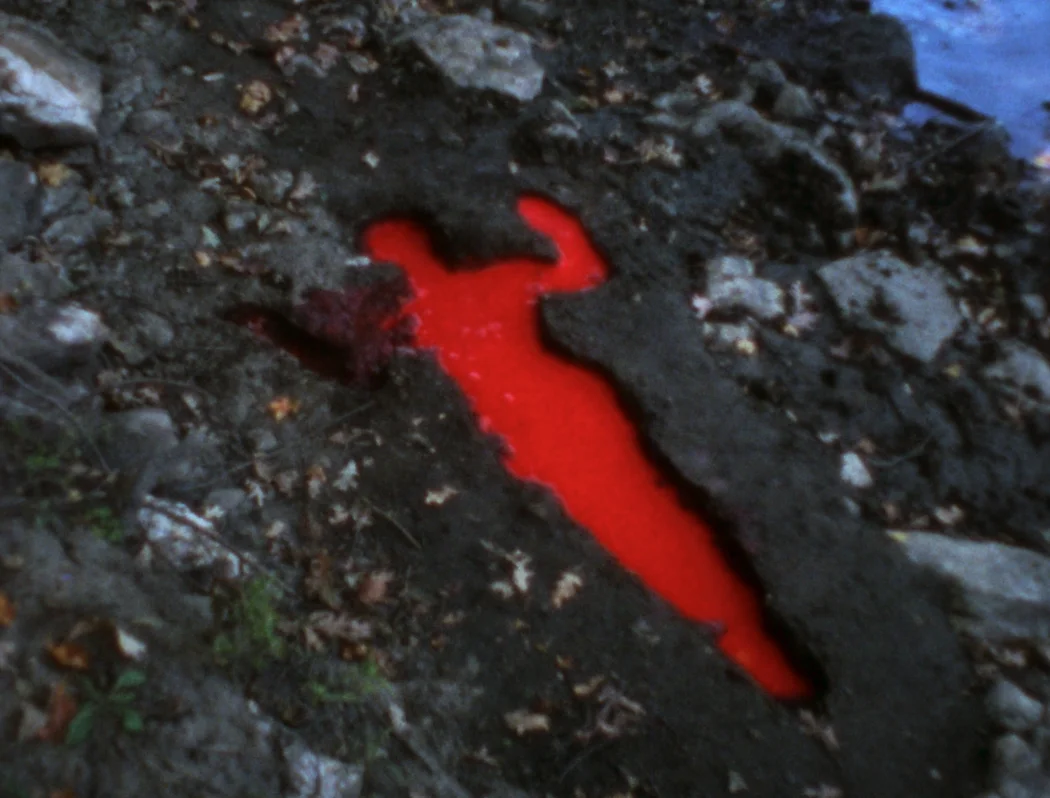
In Silueta Sangrienta (1975), filmed on the banks of Old Man’s Creek in Iowa, Mendieta dug a shallow trench into the wet earth, forming in its place the shape of a raised-arms Silueta. The film opens with Mendieta lying face up with uplifted arms within the excavated silhouette. The film cuts away to reveal the empty imprint, then again to show it filled to the brim with a bright red liquid, evoking blood. We watch the red silhouette for a moment before Mendieta reappears, lying face down and partially submerged in the now partially emptied pool.
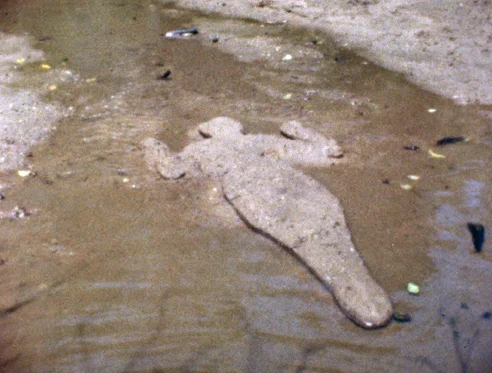
In Silueta de Arena (1978), Mendieta created a raised-arms Silueta in the shallow waters of a steady stream, forming a small island of sand. Filmed from the base of the figure, we watch the water gently flow downstream, carrying fallen leaves and twigs around the contours of the Silueta. The work embodies one of Mendieta’s recurring themes: the temporality of the human body and its inevitable return to nature.
In Birth (Gunpowder Works) (1981), Mendieta transforms the muddy bank of an Iowan creek into a sculpted, Silueta-like figure, its curved and tapering form stretching across a sandbar toward the water. Within the figure, Mendieta has carved a central opening and filled it with white gunpowder, leaving the landscape still for a few moments before the figure suddenly erupts, sending smoke trailing down its length.
Black Angel (1975) begins with Mendieta wearing all black as she lies face down on a tombstone slab beneath the looming Black Angel, a dark-winged statue in Oakland Cemetery, Iowa City, long associated with superstition and lore. Lying with her arms raised and feet together, she remains still before slowly rising from the stone, then forms a Silueta in black and then red pigment. This rarely exhibited early work is notable as we see the development of the Silueta series, which began with the artist’s own body before becoming more and more abstract over ensuing years.
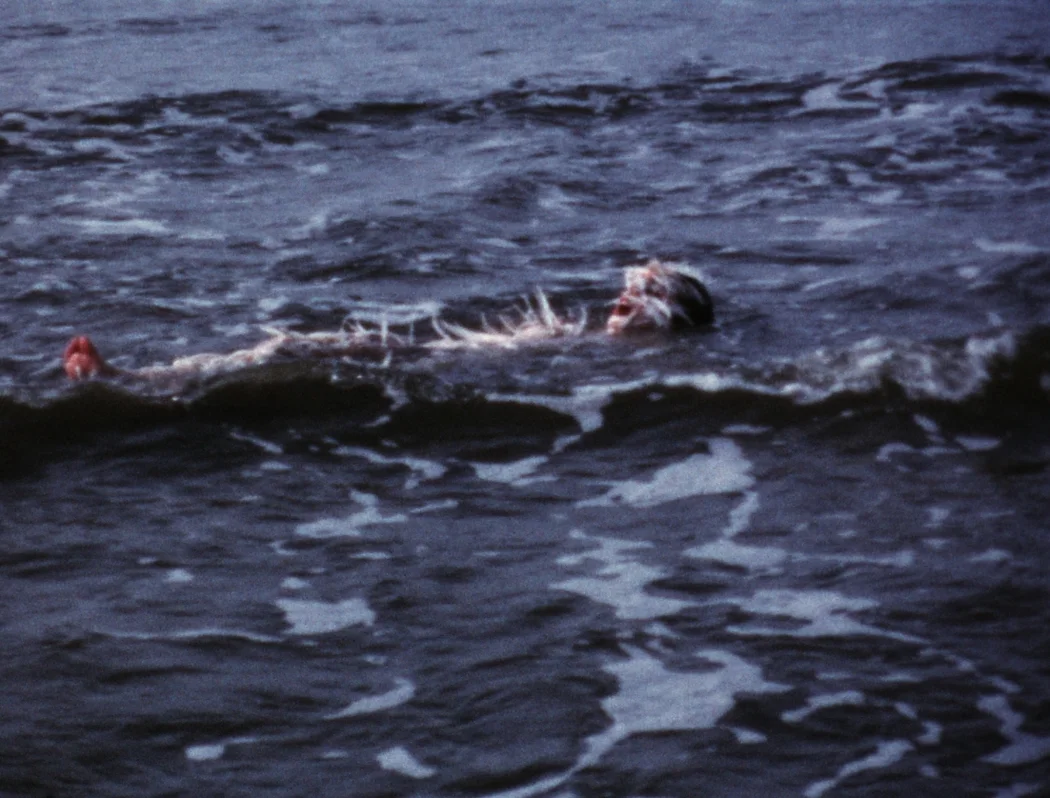
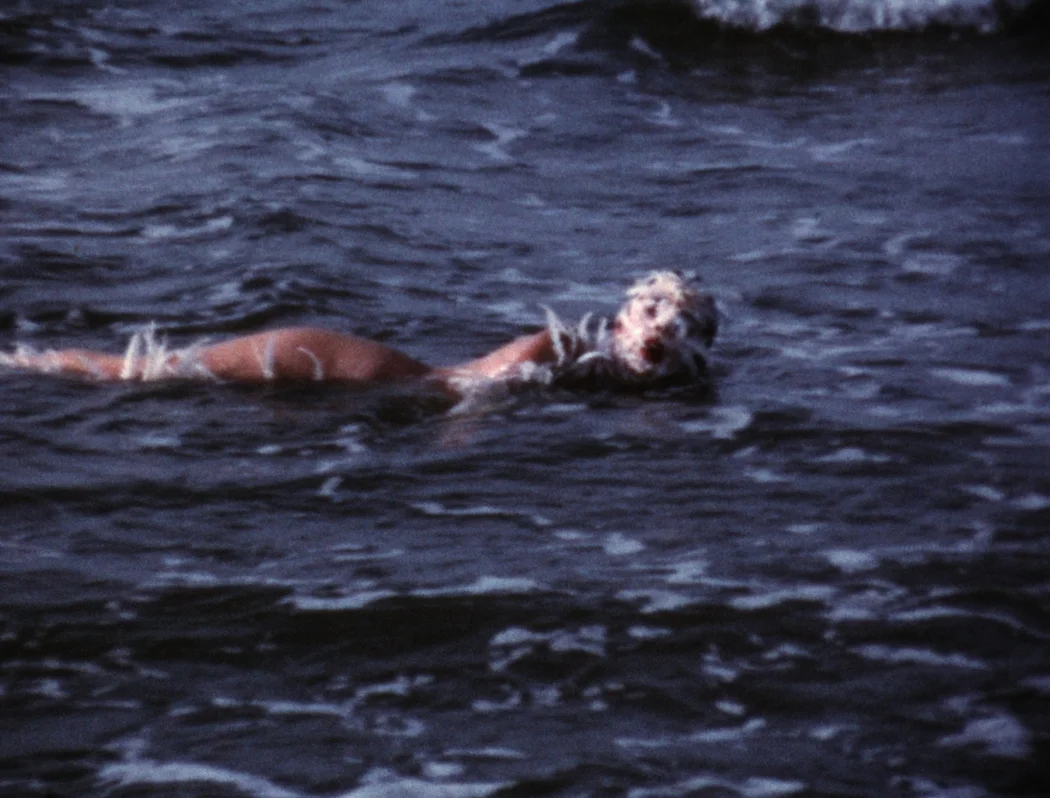
In Ocean Bird (Washup) (1974), Mendieta covers her body in white chicken feathers, continuing the avian transformation she explored just before this film in the work Bird Run, (1974), on view at the concurrent exhibition at Tate in London. She floats on her back in the gentle wash of the ocean, allowing the waves to carry and guide her body. The work becomes a meditation on transformation and dissolution. Suspended between the sea and sky, Mendieta is at times almost indistinguishable from the water and feathers that cover her body, blurring the boundary between human body and natural world.
Born in Havana (Cuba), Mendieta was sent to the United States as a young teen after Fidel Castro came to power. As a student of the renowned Intermedia MFA program at the University of Iowa in 1972, she began working with her body and with Super 8 film. Her work has been exhibited in 56 solo exhibitions, and 16 museum retrospectives including at Tate Modern (2026), Jeu de Paume, Paris, France (2018); Castello di Rivoli, Turin, Italy (2013); Smithsonian Institution, Washington, D.C. (2004); New Museum, New York, New York (1987). Mendieta received major awards in her lifetime, including a National Endowment for the Arts Grant (1977 and 1980) and Fellowship (1982); John Simon Guggenheim Foundation Fellowship (1980); Rome Prize, American Academy in Rome (1983); and many others.
The Gallery
Marian Goodman Gallery champions the work of artists who stand among the most influential of our time, representing over five generations of diverse thought and practice. What makes the gallery singular is its enduring and deep-rooted collaborations and understanding with the artists—a bond that is concurrent with curators, thought leaders, and art institutions worldwide. The Gallery’s exhibition program, characterized by its caliber and rigor, provides international platforms for its artists to showcase their work, foster vital dialogues with new audiences, and advance their practices within nonprofit and institutional realms.
Established in 1977 by Goodman, who had earlier co-founded the art publishing company, Multiples, Inc., the Gallery gained prominence early in its trajectory for introducing the work of seminal European artists to American audiences. Synchronous with the mission at hand, Marian and the Gallery were inevitably drawn to Europe, establishing a Paris location in the Marais district in 1998 and an adjacent space for books and editions in 2017. From 2014 until 2022, the Gallery also operated an exhibition space in London.
With its desire to continually explore growing areas of interest for its artists, the Gallery has opened an exhibition space in Hollywood, Los Angeles, in 2023, and will move its present New York City headquarters to an historic building in Tribeca in 2024. With two major spaces anchoring each coast, and an ongoing program for over two decades in Paris, Marian Goodman Gallery will be able to further advance new bodies of work and the creative practices of the leading contemporary artists of our time.
Information
79 & 66 rue du Temple
75003 Paris